Ayahuasca is a traditional psychoactive plant brew originating from the Amazon rainforest. It has been used for centuries by Indigenous cultures in countries such as Peru, Brazil, Colombia, and Ecuador for spiritual, medicinal, and ceremonial purposes.
The word “ayahuasca” comes from Quechua and roughly translates to “vine of the soul” or “vine of the spirits.”
Ayahuasca is not a single plant, but a combination of plants that work together chemically to produce its effects. Over time, both traditional and modern variations of the brew have developed.
Core Plants in Traditional Ayahuasca
- Banisteriopsis caapi
A woody jungle vine that forms the foundation of the brew.
It contains harmala alkaloids (MAO inhibitors), which allow DMT to become orally active.
In traditional belief systems, it is considered the guiding or spiritual backbone of the medicine. - Psychotria viridis
A leaf commonly used as the primary source of DMT (dimethyltryptamine).
DMT is the compound responsible for visionary and altered states of consciousness. - Diplopterys cabrerana (Chaliponga)
An alternative DMT-containing plant used in some Amazonian traditions, particularly in Colombia and parts of Peru.
Chaliponga can produce a somewhat different experiential profile and may contain additional alkaloids.
How the Combination Works
DMT is normally broken down in the digestive system and is not active when swallowed alone.
The harmala alkaloids in Banisteriopsis caapi temporarily inhibit monoamine oxidase (MAO), an enzyme that would otherwise break down DMT. This allows DMT from Psychotria viridis or Chaliponga to enter the bloodstream and reach the brain, producing effects that typically last 4 to 8 hours.
Without the vine, the brew would not produce the same oral psychoactive effects.
Other Forms and Variations of Ayahuasca
In addition to traditional Amazonian preparations, several related forms exist:
Regional Traditional Variations
Different Indigenous groups use slightly different plant combinations depending on geography and lineage. Additional plants may be added for specific healing, protective, or visionary purposes.
Analog Ayahuasca (Pharmahuasca)
A modern adaptation using isolated harmala alkaloids or pharmaceutical MAO inhibitors combined with pure or synthetic DMT.
This version is typically used in experimental or Western contexts and lacks the full traditional plant matrix.
Anahuasca
A term sometimes used for brews that replace traditional Amazonian plants with non-Amazonian species containing similar compounds (for example, Syrian rue as an MAOI combined with a DMT-containing plant).
Church-Based Preparations
Certain Brazilian syncretic churches prepare ayahuasca in standardized forms within structured religious ceremonies. These preparations are sometimes legally protected under religious freedom laws in specific countries.
Traditional Indigenous Setting
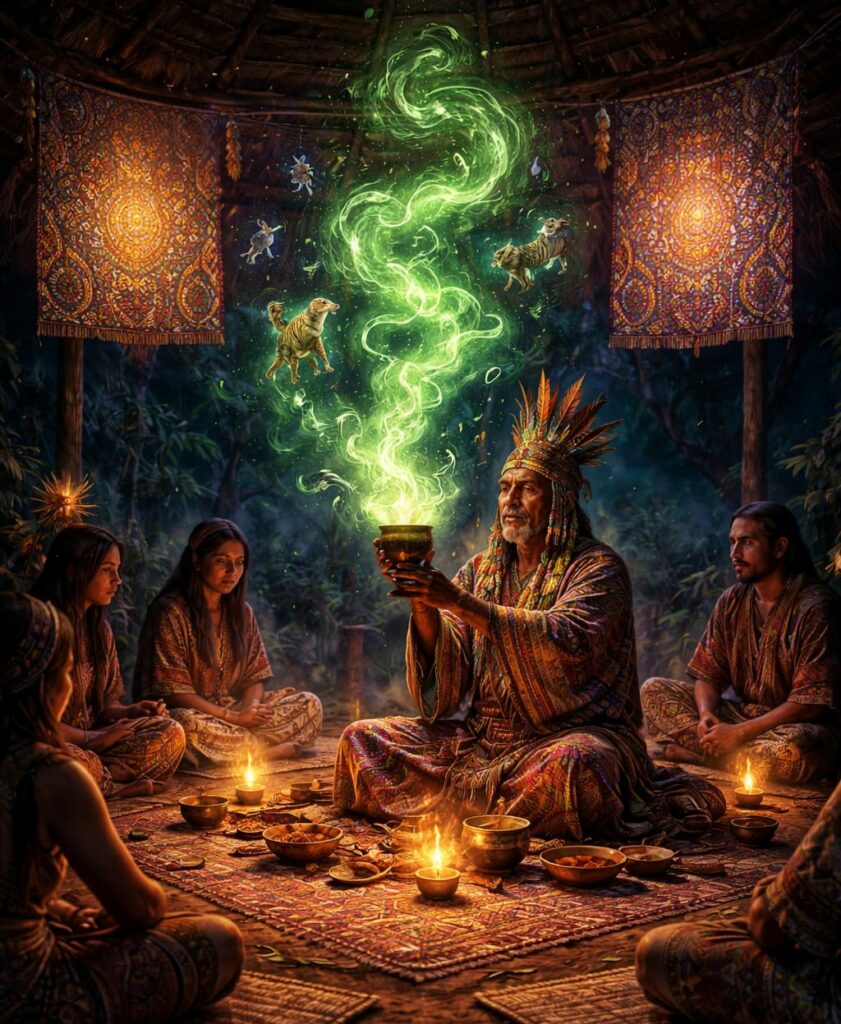
In Indigenous Amazonian cultures, ayahuasca is used within a ceremonial and spiritual framework. Ceremonies are typically led by a trained healer (curandero or shaman) and may include:
- Ritual songs (icaros)
- Dietary preparation (dieta)
- Spiritual cosmology involving plant spirits
- Community-centered healing
It is regarded as a sacred medicine rather than a recreational substance.
Western Setting and Modern Use
In Western contexts, ayahuasca is often experienced in retreat centers or private ceremonial groups in South America, Europe, or North America where it is legal or semi-legal.
The Western framing commonly emphasizes:
- Psychological healing (depression, trauma, addiction)
- Personal growth and self-exploration
- Mystical experiences interpreted through psychological language
- Integration therapy and post-ceremony processing
- While some Western ceremonies incorporate traditional songs and ritual elements, the interpretation is often more therapeutic and individual-focused rather than rooted in Indigenous cosmology.
- The emphasis tends to be on personal transformation instead of community-based spiritual practice.